Yak Collective Map

Yak Collective Map

Community Architecture & Serendipity Engineering (2020)

Network AnalysisData VisualizationCommunity DesignPrototyping
Client: Yak CollectiveYear: 2020
01

The Problem: The Dark Forest of Decentralized Work

Why indie builders fail to collaborate

Decentralized communities (like the Yak Collective) are full of brilliant indie builders, researchers, and creators. But they suffer from a 'Dark Forest' problem: members don't know what each other are working on, leading to duplicated effort and missed opportunities for interdisciplinary collision. My objective was to engineer serendipity. I conceptualized a network map to visualize the hidden overlaps in skills and interests across ~40 members to induce spontaneous collaboration.

  • Role: Community Architect & Prototyper
  • Data Source: Qualitative interest/skill data collected from ~40 Yak Collective members.
  • The Goal: Move from passive chat-room lurking to active, interdisciplinary project formation.
02

Mechanism: The Knowledge Graph

Prototyping the serendipity engine

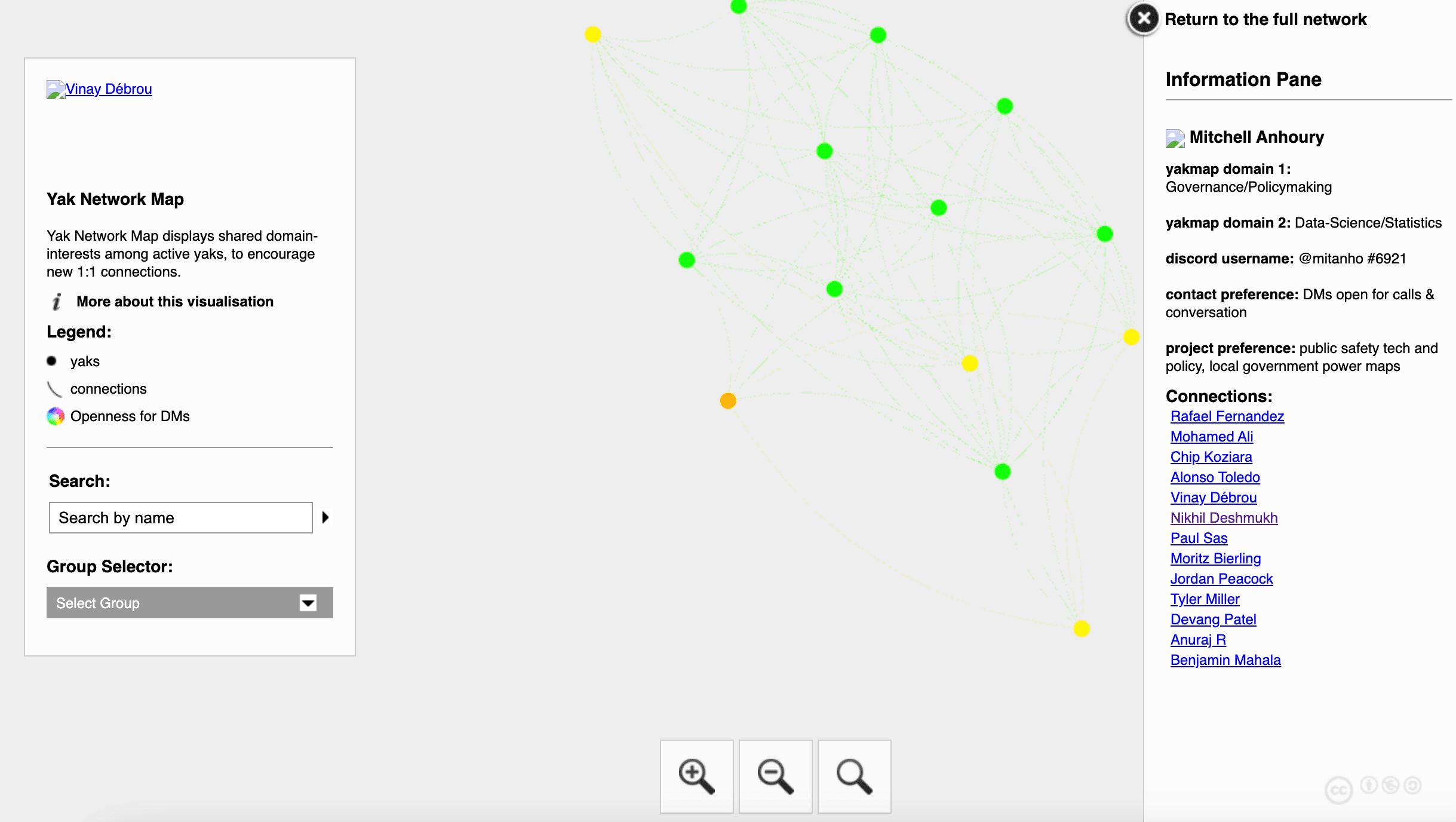
I built an interactive, force-directed network map. Instead of a standard directory, members were rendered as nodes, connected by shared domains of expertise (e.g., 'Systems Engineering' intersecting with 'Behavioral Economics'). By visualizing these hidden knowledge graphs, members could instantly identify who in the network shared their specific, niche interests, lowering the friction to reach out and start building together.

  • Data Visualization: Mapped multidisciplinary skills into an interactive graph.
  • Serendipity Engineering: Designed the UI to highlight intersections between distant nodes.
  • Frontend Prototyping: Built and deployed the live interactive web prototype.
03

Validation: Recognized by Emergent Ventures

Backing from Tyler Cowen & Mercatus Center

Network architecture is notoriously difficult to monetize or validate early. However, this prototype's approach to solving the coordination problem in decentralized networks was recognized and awarded a microgrant by Emergent Ventures (run by Tyler Cowen at the Mercatus Center). The grant validated the thesis that visualizing community knowledge graphs is a foundational step for the future of decentralized work.

  • Recognition: Awarded an Emergent Ventures microgrant (Tyler Cowen, Mercatus Center).
  • Impact: Validated the approach as a viable mechanism for solving coordination problems in online communities.
  • Future Application: The framework can be applied to any decentralized autonomous organization (DAO) or remote-first network.