Together App

Together App

0-to-1 Product Strategy & Architecture (2023)

Product Strategy0-to-1 ExecutionGrowth LoopsWeb3 Social
Client: Stealth Web3 Social StartupYear: 2023
01

Market Thesis & Product Scope

Solving digital fatigue with low-friction, hyper-local coordination

Consumer social apps face a retention crisis: Gen-Z digital fatigue is peaking, yet IRL social anxiety remains high. Existing apps optimize for passive scrolling, not active connection. Together App was built as a 0-to-1 product on the thesis that temporary, hyper-local digital icebreakers can lower the friction of spontaneous IRL meetups, while Web3 permanence drives long-term retention. I led the end-to-end product strategy, defining the core behavioral loop and architecting the UI to serve it.

  • Role: Lead Product Designer (End-to-end strategy & UI)
  • Timeline: 4-Week 0-to-1 Execution Sprint
  • Core Loop: Ephemeral Coordination -> IRL Meetup -> Onchain Permanence
  • Target: Gen Z and Millennials in close-friend networks
02

GTM Strategy: Solving the Cold Start

Architecting the hyper-local network effect

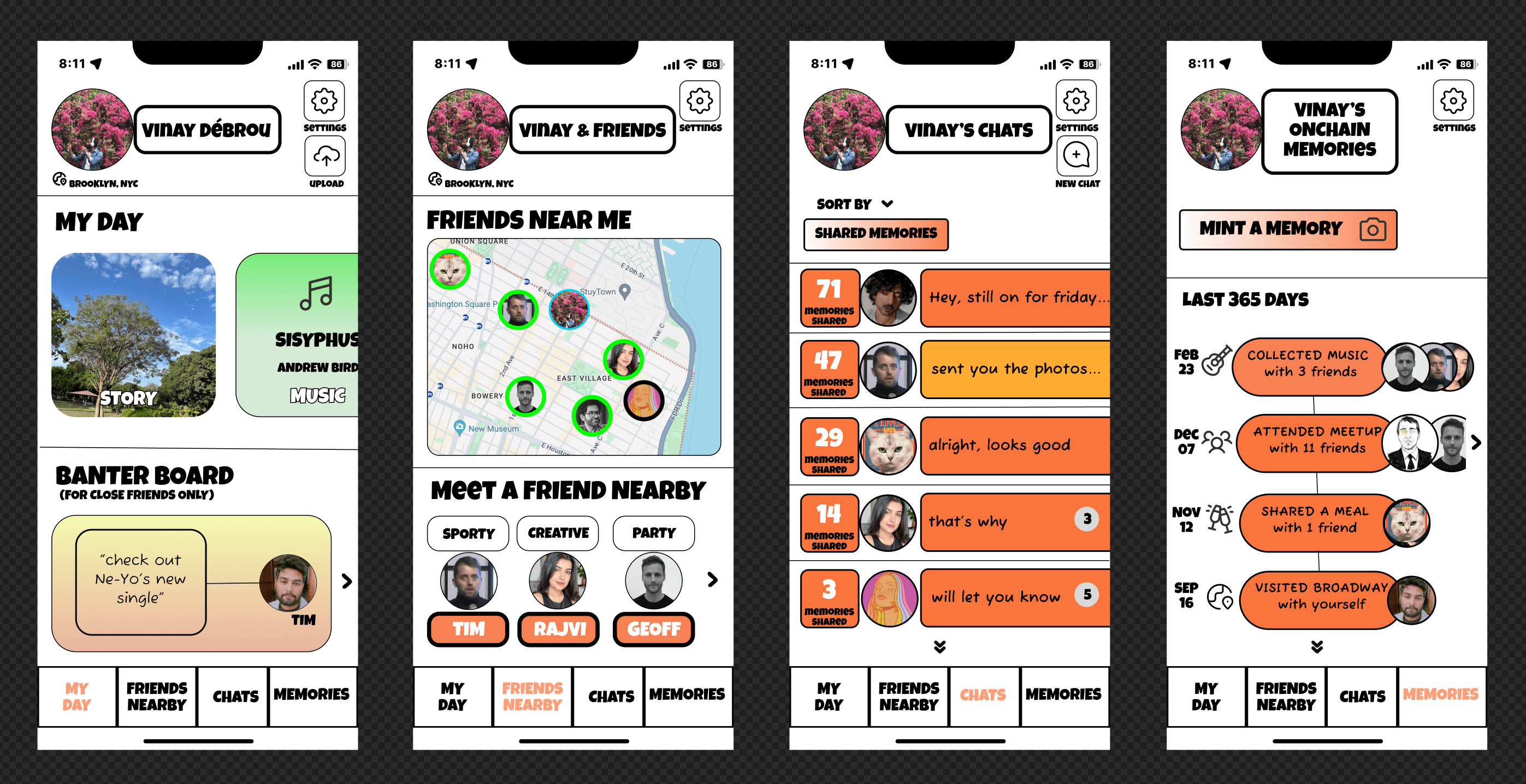
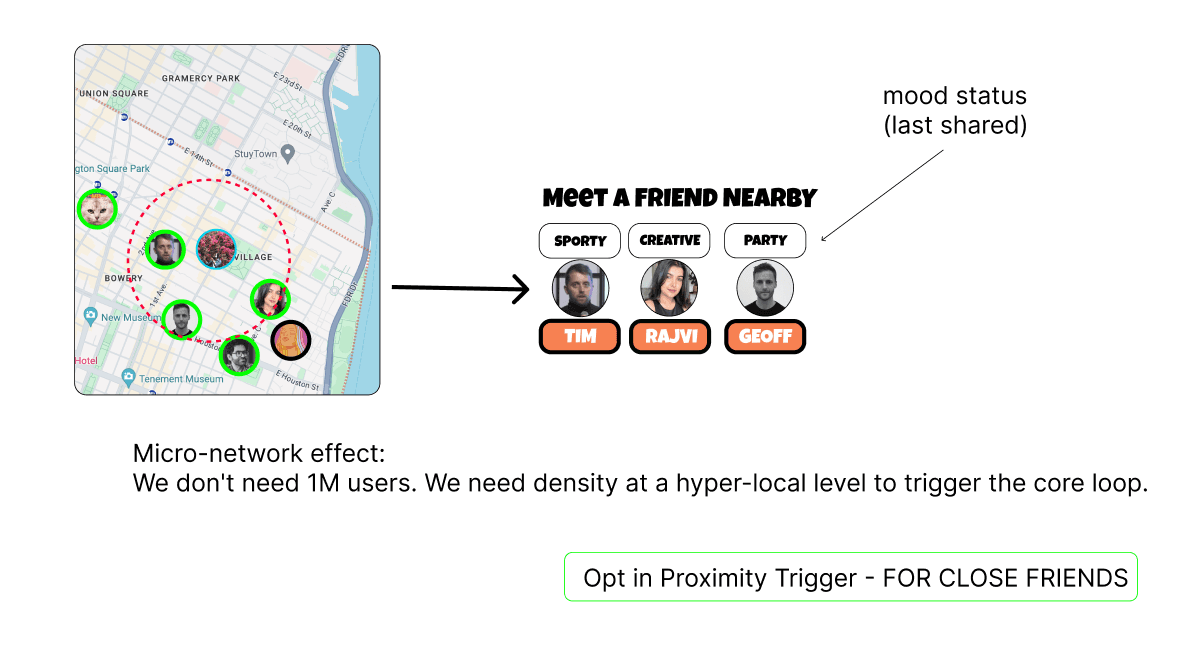
The 'empty room' problem kills 90% of consumer social apps. We could not rely on a global critical mass to launch. Instead, the product architecture was tied to a hyper-local GTM strategy. We didn't need 1M users; we needed 50 users per square mile. The 'Proximity Coordination' feature was designed as an opt-in, temporary geo-fence, enabling local network density without the privacy liabilities of constant background tracking.

  • GTM Constraint: Launched via dense, physical micro-communities (college campuses, festivals).
  • Radius-Based Discovery: Detection limited to 0.5 miles to ensure high probability of IRL execution.
  • Privacy by Design: Passive, opt-in location sharing with a 24-hour decay state to reduce social friction.
Project image 1
03

System Design: The Dual-Engine Architecture

Mapping user psychology to acquisition and retention

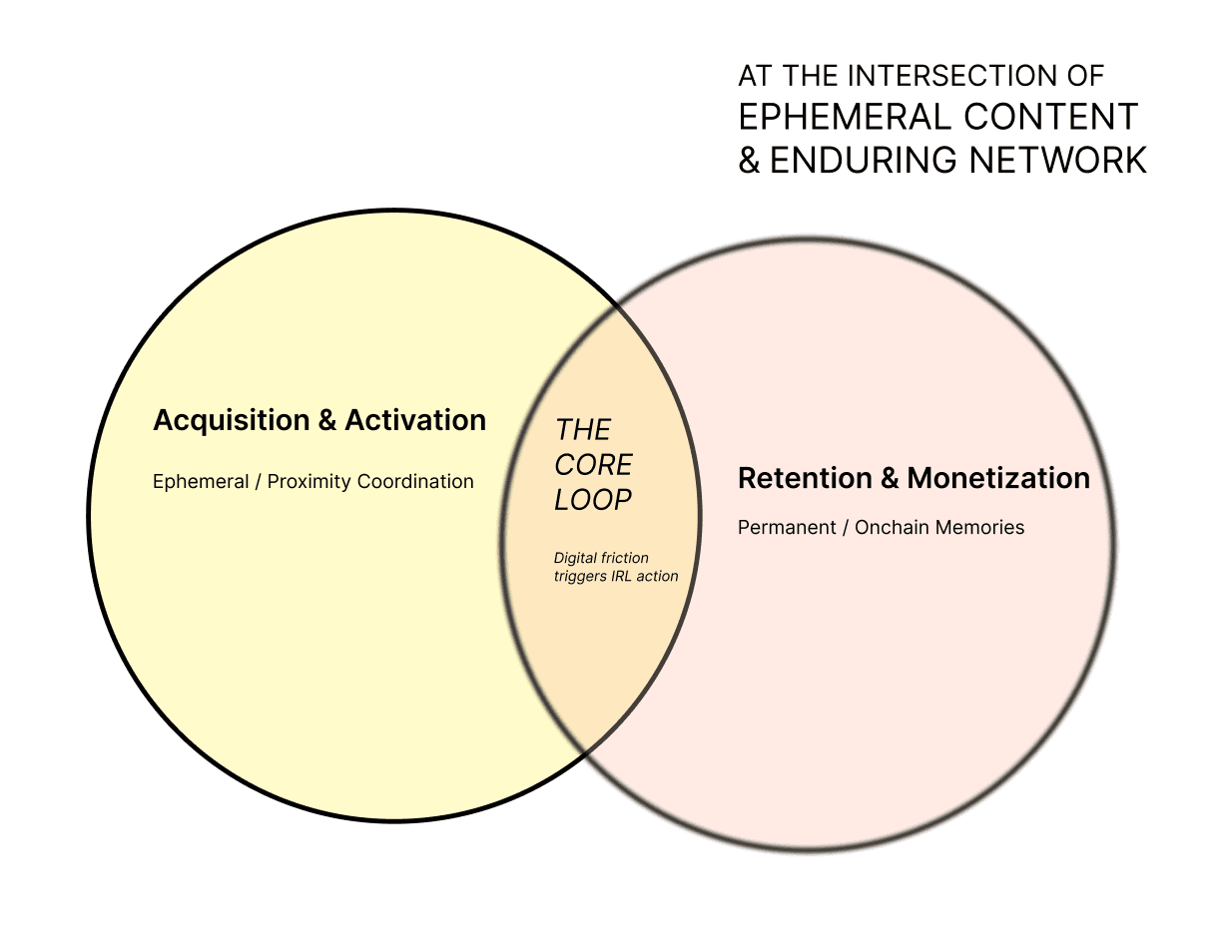
Instead of treating features as standalone UI screens, I architected a dual-engine system mapped directly to the product funnel. Ephemeral features drive top-of-funnel growth, while permanent features drive LTV. The intersection of these engines is where the app's core value lives, bridging digital intent to physical action.

  • Acquisition Layer (Ephemeral): 'Proximity Coordination' provides low-stakes, high-velocity dopamine to trigger IRL meetups.
  • Retention Layer (Permanent): 'Onchain Memories' provides psychological permanence, giving users agency over their digital footprint.
  • The Intersection: A closed-loop system where temporary digital interactions successfully trigger real-world action, which is then tokenized.
Project image 1
04

Mechanism Design: The Core Behavioral Loop

Building the engine, not just screens

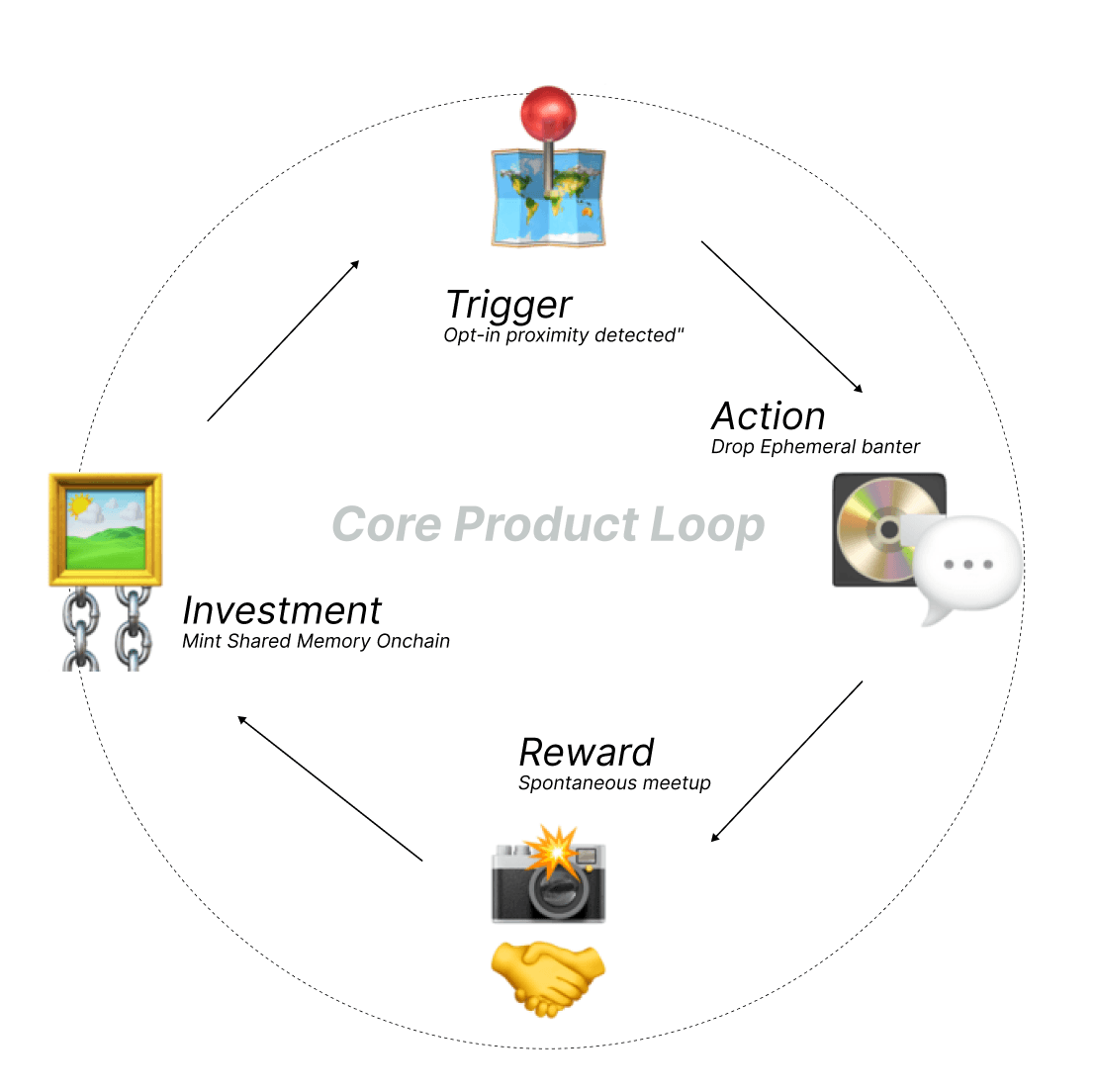
To ensure users didn't just download the app but repeatedly engaged, I designed a specific 4-step behavioral loop based on habit formation. The interface was stripped of standard social feed bloat (no infinite scrolling, no public follower counts) to force users exclusively into this loop.

  • 1. Trigger: App detects opted-in friend within 0.5 miles (Proximity).
  • 2. Action: User drops a temporary 'Banter' prompt (e.g., 'Grab coffee?').
  • 3. Variable Reward: Friends meet IRL, satisfying the digital trigger.
  • 4. Investment: They 'Mint a Memory' onchain, locking in a permanent artifact and returning to step 1.
Project image 1
05

Technical Execution: Abstracting Web3 Friction

Driving consumer adoption via invisible tech

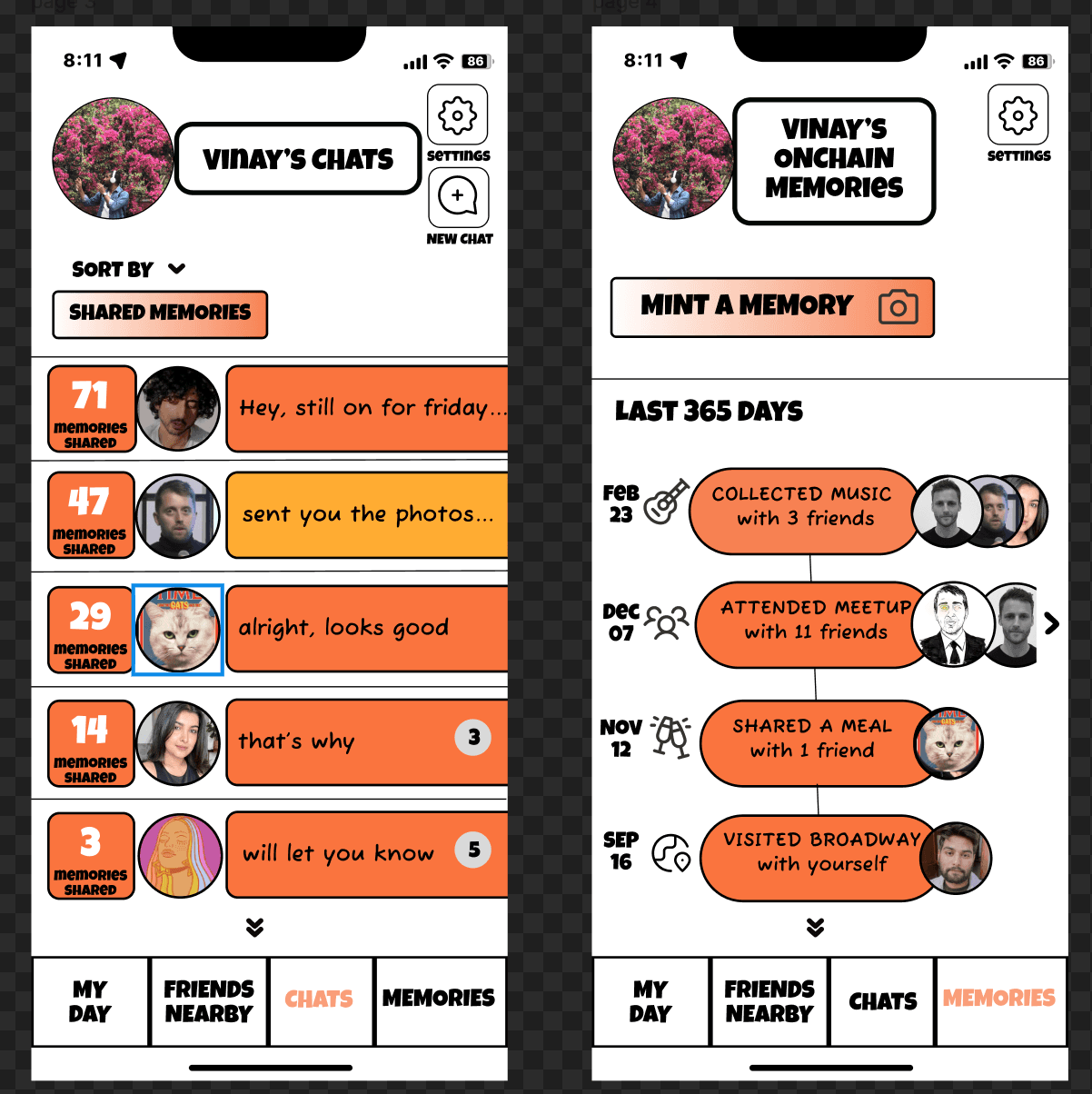
A major technical constraint was that target users didn't care about 'blockchain' or 'minting'; they cared about memories. To achieve consumer-grade adoption, I abstracted the Web3 complexity entirely. We hid gas fees, wallet signatures, and transaction hashes behind familiar Web2 UI patterns, ensuring the underlying tech stack remained completely invisible.

  • Language Translation: Replaced 'Mint NFT' with 'Mint a Memory' to focus on emotional value.
  • State Management: Used color states (pending, confirmed) to communicate system status rather than displaying transaction hashes.
  • Friction Placement: Triggered the minting flow *only* post-IRL meetup, ensuring the Web3 step felt like a rewarding culmination, not a barrier.
Project image 1
06

Metrics, Trade-offs & Defensibility

Operating like a Founder/PM

To ensure market defensibility, we prioritized the core loop over feature bloat. This required making hard trade-offs to ensure the product could survive the harsh realities of consumer social. The final interactive prototype was an execution of these operational principles.

  • North Star Metric: Weekly Active IRL Meetups Triggered. (If this grows, the network is providing real-world value, and the Web3 layer has purpose).
  • Activation: Time-to-First-Banter < 24h. (Measures the friction of the ephemeral loop; users must see immediate value upon granting location permissions).
  • Loop Conversion: Banter-to-IRL Rate (Target: 15%) and IRL-to-Mint Rate (Target: 60%). (Measures the health of the bridge between ephemeral coordination and permanent tokenization).
  • Retention Cohort Delta: D30 Retention of 'Minters' vs. 'Non-Minters'. (Validates the core thesis that onchain permanence acts as a retention moat).
  • The Trade-off: Sacrificed rich profile customization and public feeds to optimize for high-velocity, low-pressure interactions. We optimized for IRL meetups, not digital screen time.
07

Post-Mortem: Builder Takeaways

Operational insights from 0-to-1 execution

This sprint validated that emerging technology (Web3) must serve human behavior, not dictate it. Building this product reinforced key operational truths about the harsh realities of launching consumer social apps:

  • Architecture follows GTM: A beautiful UI fails if the product architecture doesn't solve the local network effect (cold start).
  • Invisible Web3 is the only viable Consumer Web3: Adoption requires hiding the underlying tech stack completely behind human-centric language.
  • Behavioral Lock-in: Ephemeral features drive DAU/MAU, but permanent features (tokenized memories) are what drive LTV and defend against churn.